10 minute read
AI maturity is not a technology problem. It's a culture problem you can measure.
Why HR leaders are now on the front line of AI deployment — and how to make visible what technical dashboards miss.

5 mai 2026
Your AI tools are deployed. Your Copilot licenses are live. And yet, usage is stalling, the promised ROI is slow to materialize, and some teams — often your most experienced ones — seem to be dragging their feet. The bottleneck is rarely technical. It’s psychological. And it has a name: the psychological debt of AI.
Your AI tools are deployed. Your Copilot licenses are live. And yet, usage is stalling, the promised ROI is slow to materialize, and some teams — often your most experienced ones — seem to be dragging their feet. The bottleneck is rarely technical. It’s psychological. And it has a name: the psychological debt of AI.
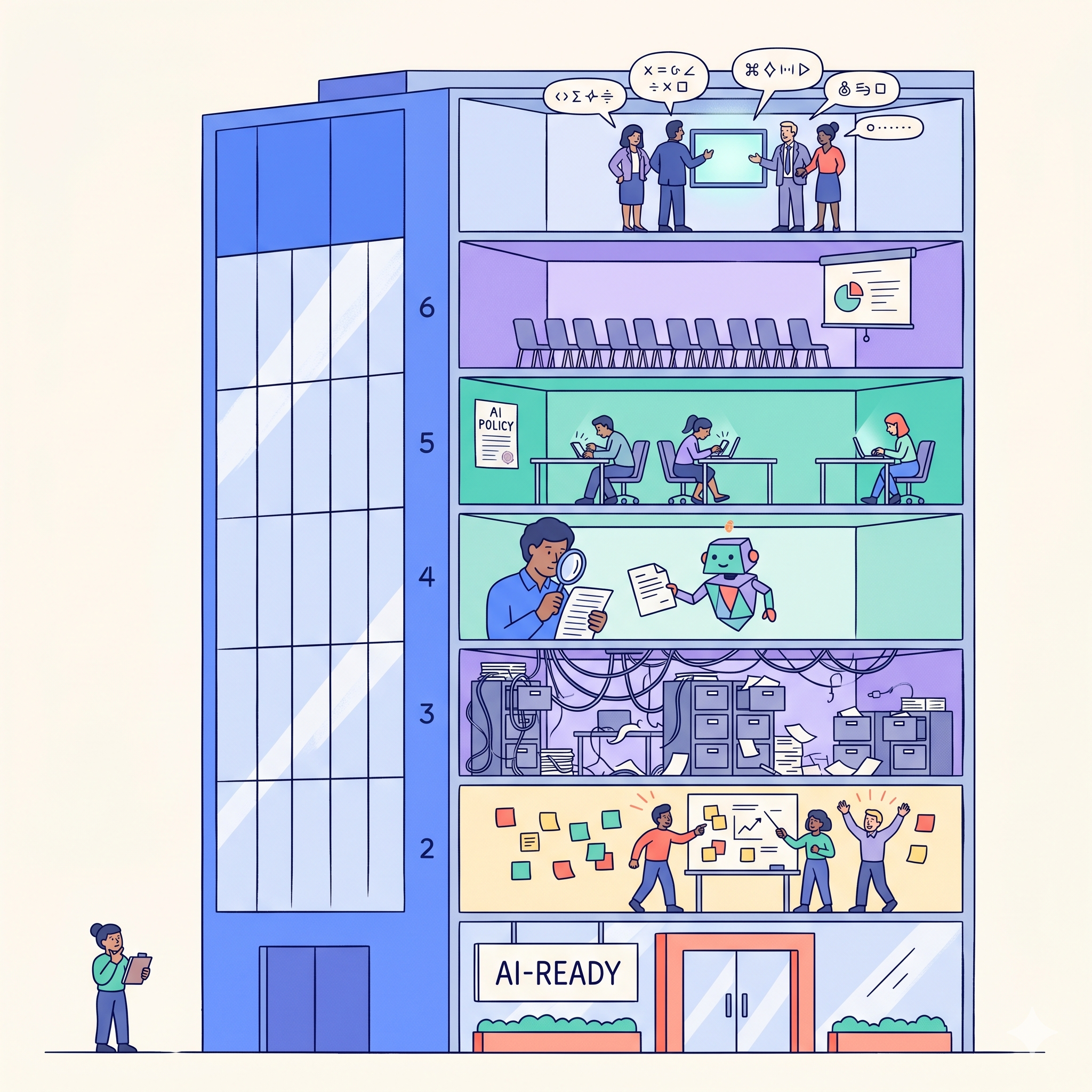
AI adoption in the workplace rarely fails because of the tool. It fails because unstructured AI use creates six psychological costs — cognitive, autonomy, competency, relatedness, credibility, and identity — that erode motivation and trigger avoidance behaviors. Recent research by Guy Champniss (Meltwater Consulting, IE Business School) across 1,200 employees shows that workers carrying high psychological debt use AI nearly twice as little, and on far less strategic tasks. The answer isn’t more technical training. It’s a redesign of the psychological contract between the employee, their role, and AI.
Executive teams approach AI as a productivity question. CIOs approach it as a technical integration challenge. HR leaders inherit the actual problem: why are employees not using — or misusing — tools whose value they openly acknowledge?
The work of Guy Champniss, professor at IE Business School and founder of Meltwater Consulting, offers a new lens, published in Harvard Business Review in May 2026. Across 1,200 full-time employees in the US and the UK, his team measured what he calls psychological debt — the bundle of psychological costs that unstructured AI use places on workers.
The findings are unambiguous. Employees with high psychological debt score 60 out of 100, compared to 36 for those who use AI multiple times a day. The first group confines AI to simple tasks; the second integrates it into strategic decisions. This isn’t a generational issue or a question of tech-savviness. It’s an issue of identity, perceived competence, and felt autonomy.
Champniss identifies six distinct dimensions. Each maps onto a psychological mechanism that was documented well before generative AI arrived — which makes them actionable levers, not speculation.
Cognitive debt. As employees offload thinking to AI (cognitive offloading), they progressively lose fine-grained understanding of the problem and ownership of the solution. The reflex of “let me open ChatGPT” replaces the upfront framing effort.
Autonomy debt. When AI is imposed top-down in the name of productivity, it’s experienced as a loss of control over how one works. Autonomy is one of the three pillars of intrinsic motivation in self-determination theory. Eroding it produces quiet quitting, not performance.
Competency debt. The more I use AI, the less competent I feel. The paradox is brutal: the tool produces in seconds a deliverable cleaner than what I can produce alone. Self-efficacy erodes, and dependency sets in.
Relatedness debt. AI never argues, never tires, has infinite patience. It silently replaces the working interactions that used to produce peer learning and team cohesion. Champniss cites a major UK university investing over £200 million to reintroduce human collaboration — precisely because AI had quietly erased it.
Credibility debt. Many employees perceive that admitting “I used AI” diminishes their credibility with peers — even when those same peers are using it covertly. This is one of the main drivers of shadow AI in the workplace.
Professional identity debt. This is the most powerful of the six. When AI enters tasks that define what it means to be a creative, a doctor, a consultant, an engineer — it’s experienced as an attack on the group’s identity. Clinicians have voiced this clearly; so have creative professionals.
| Indicator | Low psychological debt | High psychological debt |
|---|---|---|
| Average score (out of 100) | ~36 | ~60 |
| AI usage frequency | Multiple times per day | Rare |
| Complexity of tasks delegated to AI | Strategic | Simple |
| Avoidance behavior | Low | High |
| Typical profile | Senior (20+ years experience) | Junior (0-5 years) |
Source: Champniss, HBR, May 2026 (n = 1,200, US + UK).
The counter-intuitive finding lies in the junior profile. One might expect digital natives to be the most at ease. The opposite is true: their debt is higher (54 vs 40 for seniors). The reason is competency debt — early in their careers, employees need to demonstrate technical expertise, and AI threatens precisely that ground.
Most AI adoption plans rely on three levers: tool training, communication of use cases, and measurement of usage frequency. None of the three addresses the root cause. All three address symptoms.
Champniss’s framework offers a different read: before deploying an AI tool into a workflow, you need to diagnose the likely psychological debt within the affected population and design specific countermeasures for each of the six debts. Here’s how that translates operationally.
Don’t allow AI use until the employee has formulated an initial hypothesis or argument. JP Morgan explicitly positions its internal AI as an insights provider, not a decision-maker — AI suggestions are useless unless they fit into a pre-existing human reasoning thread.
Rather than dictating the AI scope from above, let teams surface the moments when AI actually helps. ING’s AI Principles in Practice program requires every product team to explicitly document how human judgment is preserved before any model goes live.
Microsoft’s Copilot Champs Community initiative relies on peer ambassadors rather than top-down trainers. The logic: each employee explores AI’s relevance in their role context, which preserves their sense of competence.
At P&G, cross-functional teams collectively review outputs from innovation chatbots. Performance increases, but more importantly, silos dissolve — AI becomes a reason to collaborate, not to isolate.
Klarna turned its Kiki assistant into a cultural artifact: 90% adoption within a year, 250,000 questions handled, explicit internal communication that experimentation is the norm. When usage becomes public and valued, credibility debt collapses.
Philips, in healthcare, never says “AI will help radiologists save time.” Instead, it says: “AI increases the clinician’s diagnostic precision, frees their expertise from logistical tasks, and makes the expert’s value visible in multidisciplinary coordination.” The shift is subtle but decisive: AI strengthens the clinician’s identity rather than diluting it.
Three direct implications for HR functions:
First, pre-deployment psychometric audits become a strategic asset. Before scaling AI tools, mapping the likely psychological debt across populations lets you anticipate friction zones and calibrate the right support. This is exactly where behavioral assessment and soft-skills tools deliver immediate ROI.
Second, soft skills development becomes a precondition for AI adoption, not a parallel topic. Critical thinking, self-awareness, emotional regulation, and collaboration are the very competencies that allow employees to keep control over the six debts. An AI program without a soft-skills layer is a program with diminished ROI.
Third, professional identity moves back to center stage. The competency models that define managerial, engineering, consulting, or clinical roles need to be explicitly rewritten to spell out what AI strengthens and what it leaves untouched. Without that work, identity debt will derail even the best adoption plans.
AI adoption isn’t a question of licenses or use cases. It’s a question of motivation, identity, and connection — in other words, the core territory of the HR function. The first useful step isn’t another technical pilot. It’s a diagnosis: where does AI psychological debt live in your teams, on which dimensions, and with what intensity? Without that map, every euro invested in the tool is silently taxed by the avoidance behaviors it triggers.